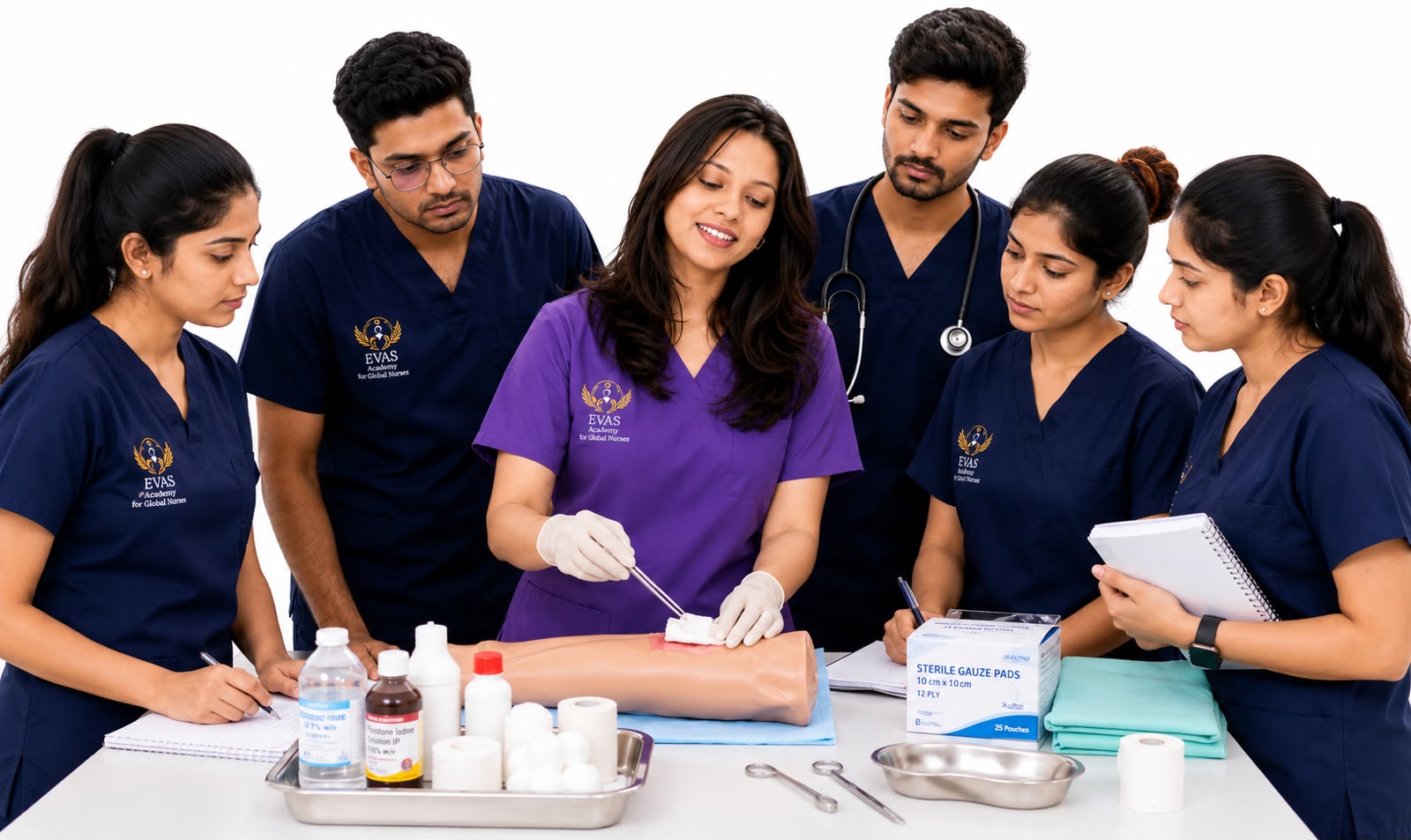


IQN Training in Kerala New Zealand Nursing Registration Preparation at EVA's Academy

New Zealand is one of the world’s most rewarding destinations for internationally qualified nurses — a country where nursing roles are listed as Tier 1 on the national Green List, permanent residency pathways are available upon registration, and the healthcare sector actively welcomes skilled professionals from abroad.
At the centre of the New Zealand registration pathway for most internationally qualified nurses sits one critical requirement: the IQN Theoretical Examination. This computer-based assessment determines whether your clinical knowledge meets the standards required to practise safely in New Zealand’s healthcare environment. It is rigorous, time-pressured, and requires preparation that goes significantly beyond general nursing revision.

Preparing independently — without structured guidance, mock assessments, or expert feedback — leaves most candidates underprepared for the specific demands of the IQN examination format.
EVA’s Academy provides specialist IQN Training in Kerala for internationally qualified nurses, offering structured theory preparation, personalised mentoring, and ongoing support throughout your New Zealand nursing registration journey.

Book a Consultation See Our Approach
IQN Training

What Is IQN and Why Is It Important for New Zealand Nursing Registration?

IQN stands for Internationally Qualified Nurse — the term used by the Nursing Council of New Zealand (NCNZ) to describe nurses who trained and qualified outside Australia and New Zealand.

For most IQN applicants, the NCNZ registration pathway includes a mandatory competence assessment consisting of two stages: the IQN Theoretical Examination followed by a clinical competence assessment (OSCE). The theoretical examination is a computer-based multiple-choice test delivered through Pearson VUE, designed to assess whether an internationally qualified nurse has the nursing knowledge required to practise safely in Aotearoa New Zealand.

Passing the IQN theoretical examination is not optional — it is a regulatory gateway. Without it, registration with the Nursing Council of New Zealand cannot proceed for candidates directed to competence assessment. Structured, examination-focused preparation is the most reliable route to a first-attempt pass.

What Skills and Competencies Are Assessed During IQN Preparation?

Registered nurse candidates sit 120 questions in 165 minutes: Part A has 12 medication safety questions in 30 minutes and Part B has 108 nursing knowledge questions in 135 minutes. Both sections carry equal importance — a strong performance in Part B does not compensate for a poor Part A result. Understanding what each section actually assesses — and how to prepare for it specifically — is what separates effective IQN Training in Kerala from generic nursing exam coaching.
  • Professional Nursing Practice

    Part B of the IQN examination is closely aligned to the NCNZ’s registered nurse competency framework. Questions assess your understanding of New Zealand’s professional standards, scope of practice, ethical obligations, patient rights under the Health and Disability Commissioner (HDC) Code, and professional accountability. Nurses who have not specifically studied New Zealand’s legislative and professional framework — which differs from Indian, UK, or Middle East nursing standards — frequently underperform in this domain even with strong general clinical knowledge.

  • Medication Safety

    Part A covers medication and fluid safety questions including medicine calculations. This section requires precision — drug dosage calculations for oral, intravenous, intramuscular, and subcutaneous routes, fluid management, and the identification of unsafe medication practices. One calculation error in Part A represents a significant proportion of that section’s available marks. Structured, repeated calculation practice under timed conditions is essential preparation for this domain.

  • Clinical Decision Making

    Scenario-based questions in Part B assess your ability to interpret clinical information, identify deteriorating patients, prioritise care needs, and select the safest nursing action within a defined clinical context. These questions require a New Zealand-specific clinical reasoning approach — not simply the application of general nursing knowledge. Candidates who practise scenario analysis systematically perform significantly better in this domain than those who revise content without practising applied questions.

  • Patient-Centred Care

    The IQN examination reflects New Zealand’s strong commitment to patient-centred, culturally safe nursing practice. Questions in this domain assess your understanding of informed consent, patient education, whānau involvement, cultural competence, and the principles of the Treaty of Waitangi as they apply to nursing practice. This is an area that many internationally qualified nurses have not encountered in previous training and requires specific preparation.

  • Communication and Documentation

    Effective communication within the multidisciplinary team, structured clinical handover, and accurate documentation are assessed throughout Part B. Questions cover ISBAR communication, incident reporting, delegation, and escalation of clinical concerns — all within New Zealand’s professional and legal documentation framework.

  • Critical Thinking in Clinical Settings

    Across both parts of the examination, candidates are expected to demonstrate higher-order clinical reasoning — applying knowledge to novel situations rather than recalling facts. This is the competency that separates well-prepared candidates from those who have studied content without developing examination technique.

  • New Zealand Nursing Standards and Cultural Safety

    The IQN examination assesses your understanding of New Zealand nursing standards, NCNZ competencies, cultural safety principles, and the importance of providing respectful, patient-centred care. Candidates may encounter questions related to Te Tiriti o Waitangi (Treaty of Waitangi), cultural responsiveness, and professional practice expectations within the New Zealand healthcare system. As these concepts differ from many international healthcare environments, focused preparation is essential for success.

Evas Academy Support

Talk to our experts. We are available 7 days a week, 10 AM to 7 PM

Prepare with Confidence

How EVA's Academy Helps You Prepare with Confidence

At EVA's Academy, our IQN New Zealand Coaching Kerala programme is designed around one objective — helping you pass the IQN theoretical examination efficiently, confidently, and without avoidable re-attempts.

Personalised Mentoring

Every candidate’s preparation plan is built around their individual knowledge profile, identified gaps, and examination timeline — not a generic syllabus applied uniformly to every student. Personalised preparation is more efficient and consistently produces better outcomes than classroom-average teaching.

Individual Performance

Tracking Progress is tracked separately across Part A (medication safety) and the major domains of Part B (professional practice, clinical decision-making, patient-centred care, communication). Candidates always know precisely where they stand — and where to direct their next preparation effort.

Small Batch Learning(maximum (maximum 12 learners)

Limited group sizes ensure every candidate receives meaningful trainer interaction and personalised feedback at every session. EVA’s Academy does not use large-batch delivery models that prevent individual attention.

Practical, Applied Learning Approach

Content delivery is paired with scenario-based question practice throughout the programme. Candidates develop clinical reasoning skills and examination technique simultaneously — not sequentially.

Progress Reviews and Plan Adjustment

At defined checkpoints throughout the programme, performance data is reviewed and preparation plans are adjusted where needed. Candidates who are progressing well move toward mock examination readiness; those with persistent gaps in specific domains receive targeted intervention sessions before proceeding.

Exam Readiness Support

Preparation does not stop at content coverage. EVA’s Academy supports candidates through examination registration guidance, preparation timelines, and pre-exam readiness evaluation — ensuring you sit the IQN theoretical examination only when your mock performance demonstrates genuine readiness.

Our Preparation Methodology

EVA's Academy's IQN preparation follows a structured, five-stage methodology that is systematic, measurable, and adapted to each candidate's individual starting point.
1

Initial Assessment 

Every candidate begins with a diagnostic assessment across Part A (medication safety) and the core Part B domains. This establishes a baseline knowledge profile and identifies specific gaps before preparation begins — ensuring time and effort are allocated where they are most needed from day one.

2

Personalised Learning

Plan Assessment results are used to build a candidate-specific preparation plan with defined topic sequences, time allocations, and assessment milestones. Candidates with strong medication calculation skills but weaker New Zealand professional practice knowledge receive a plan weighted accordingly — not an equal-distribution generic timetable.

3

Structured Learning Sessions

Preparation follows a systematic curriculum covering Part A medication safety in full and all major Part B domains — professional nursing practice, clinical decision-making, patient-centred care, communication, and cultural competence. New Zealand-specific content is integrated throughout, not delivered as a separate module.

4

Practice Activities and Mock Assessments 

Scenario-based question practice is incorporated from the earliest sessions. Full mock examinations — 120 questions under timed conditions — are conducted at defined intervals throughout the programme. Every mock examination is followed by a structured review session with domain-level performance analysis and specific improvement guidance.

5

Performance Review and Continuous Improvement 

Ongoing performance data is reviewed at regular checkpoints. Where progress in a specific domain is slower than expected, targeted intervention sessions replace standard content delivery until the gap is addressed. The programme advances at the pace that preparation outcomes — not calendar duration — dictate.


Warning: Undefined array key "sect_image" in /home/u856994935/domains/evasacademyglobal.com/public_html/wp-content/themes/evas/single-courses.php on line 1674

Who Should Consider IQN Training?

IQN training is designed for a specific and clearly defined group of nursing professionals. Understanding whether this pathway applies to you is the essential starting point.

Registered Nurses Planning New Zealand Registration If you are an internationally qualified registered nurse applying to the NCNZ without current Australian registration, the NCNZ will assess your application and direct you toward competence assessment if required. This triggers the IQN theoretical examination requirement. Structured IQN Training in Kerala ensures you approach this examination with the preparation, confidence, and examination technique it demands.

Nurses Preparing for the IQN Theoretical Examination Candidates who have already received their NCNZ invitation to sit the examination have six months to complete it successfully. Focused, structured preparation within this window — with mock assessments, performance tracking, and expert guidance — maximises your probability of a first-attempt pass.

Nurses Seeking Mentored Preparation Many clinically experienced nurses find that independent study does not translate effectively into examination performance. If you have strong clinical skills but limited experience with the IQN examination format, structured mentoring with regular feedback is the most efficient preparation approach.

Professionals Building a Long-Term New Zealand Nursing Career For nurses committed to a nursing career in New Zealand, the IQN examination is the first formal milestone. Passing it with a thorough understanding of New Zealand nursing standards, professional expectations, and clinical frameworks also prepares you for the clinical environment you will enter after registration.


Understanding the New Zealand Nursing Registration Journey

The New Zealand nursing registration pathway for internationally qualified nurses has been significantly updated since December 2023. The process now takes approximately 6 to 9 months for internationally trained nurses to secure registration and permanent residency through a Straight to Residence visa.

 TruMerit Credential Verification

Before applying to the Nursing Council of New Zealand, TruMerit must verify your credentials. TruMerit, formerly known as CGFNS, independently confirms your qualifications, nursing registration, and professional history. This stage requires a complete, accurate document submission — delays here directly extend your overall registration timeline.

NCNZ Application and Assessment

Once TruMerit verification is complete, you apply to the NCNZ. The Council reviews your application and determines whether competence assessment is required. For applicants in the international pathway, current NCNZ guidance says some registered nurse applicants and all enrolled nurse applicants need competence assessment, which includes the IQN theoretical examination followed by clinical competence assessment.

Welcome to Aotearoa Online Course

All IQN applicants must complete the free online Welcome to Aotearoa course, which introduces Te Tiriti o Waitangi and culturally safe nursing practice in New Zealand. Completion certificates must be uploaded to the NCNZ MyIQN portal.

IQN Theoretical Examination

Candidates directed to competence assessment receive an email invitation to sit the IQN theoretical examination through Pearson VUE. You have six months from the date of invitation to complete the examination successfully. This is where structured preparation makes the critical difference.

OSCE and Registration

Candidates who pass the theoretical examination proceed to the OSCE — an in-person clinical competence assessment conducted in New Zealand. Upon passing, NCNZ registration is granted, enabling employment under a work visa or Straight to Residence visa.

Understanding where the IQN examination sits within this journey — and what comes before and after it — helps candidates plan their preparation timeline intelligently from the outset.

Registration and Employment Pathway

After obtaining NCNZ registration, nurses can actively pursue employment opportunities across New Zealand’s public and private healthcare sectors, including hospitals, aged care facilities, community healthcare services, rehabilitation centres, and specialist healthcare settings.

Common Challenges Faced by IQN Candidates and How Structured Training Helps

Many highly experienced nurses find the IQN examination genuinely challenging — not because they lack clinical competence, but because the examination format, New Zealand-specific content, and timed conditions present obstacles that clinical experience alone does not overcome.

Understanding New Zealand-Specific Nursing Expectations

New Zealand’s nursing standards, legislative framework, and cultural practice requirements are distinct from those in India, the Gulf, or the UK. Candidates who revise general nursing knowledge without specifically studying New Zealand’s professional context frequently encounter unfamiliar question content in Part B. Structured IQN New Zealand Coaching in Kerala addresses this directly — building New Zealand-specific knowledge alongside general clinical preparation.

Medication Calculation Accuracy Under Time Pressure

Twelve medication safety questions in thirty minutes demands both accuracy and pace. Candidates who have not practised drug calculations regularly under timed conditions find that the time pressure of Part A affects both their accuracy and their composure for Part B.

Scenario-Based Clinical Reasoning

The shift from recalling nursing knowledge to applying it in scenario-based multiple-choice questions requires deliberate, structured practice. Many candidates underestimate this transition until they sit their first mock examination — at which point a significant portion of their six-month examination window has already elapsed.

Examination Anxiety

The stakes attached to the IQN examination — a failed attempt delays registration, extends your timeline, and has financial implications — create significant performance pressure. Regular mock assessments under examination conditions consistently reduce anxiety by replacing uncertainty with familiarity.

Study Planning and Time Management

Candidates managing full-time work, family responsibilities, and exam preparation simultaneously frequently struggle with unstructured self-study. A defined preparation plan with clear milestones, regular assessment checkpoints, and expert guidance prevents the inconsistent preparation patterns that lead to avoidable failures.

Why Exam Readiness Matters More Than Course Completion

Many coaching programmes measure success by course completion — the number of sessions attended or topics covered. At EVA’s Academy, exam readiness is the only meaningful measure of preparation progress.

A candidate who has attended every session but cannot consistently achieve passing scores in mock examinations is not ready to sit the IQN theoretical examination — regardless of how much content has been covered. Conversely, a candidate whose mock performance demonstrates consistent competence across both parts is genuinely ready, irrespective of how long preparation has taken.

This readiness-focused approach protects candidates from premature examination attempts that result in avoidable failure — and the financial cost, timeline delay, and confidence impact that accompany them. EVA’s Academy’s pre-exam readiness evaluation is one of the most practical and honest services we provide: an independent assessment of whether you are genuinely prepared before you commit to an examination date.


Learn from Experienced Nursing Educators

Every preparation session at EVA’s Academy is facilitated by healthcare educators with direct clinical backgrounds and specialist knowledge of international nursing licensing examinations, including the IQN theoretical examination framework and NCNZ competency standards.

Our faculty understands the specific challenges faced by Kerala nurses transitioning to New Zealand’s healthcare environment — the professional practice differences, the cultural competence requirements, and the clinical reasoning approach the IQN examination demands. Mentoring at EVA’s Academy is not generic — it is candidate-specific, experience-informed, and focused on practical preparation outcomes rather than content delivery alone.


Beyond Coaching — Support Throughout Your New Zealand Nursing Journey

EVA’s Academy’s support extends beyond the IQN theoretical examination itself. We understand that the registration journey involves multiple stages, and our team provides guidance at each one.

Preparation for the OSCE Candidates who pass the IQN theoretical examination proceed to the OSCE — the in-person clinical competence assessment conducted in New Zealand. EVA’s Academy provides OSCE-focused preparation support for candidates planning this next stage, ensuring continuity of preparation across both components of the competence assessment.

Study Resources and Materials Candidates receive structured study materials aligned to the IQN examination framework, including New Zealand-specific professional practice content, medication safety resources, and scenario-based practice questions developed for the IQN format.

Progress Monitoring Throughout Preparation Ongoing performance monitoring means candidates are never uncertain about their preparation status. Regular assessment, structured feedback, and clear milestone tracking give candidates — and their families — the confidence that preparation is progressing purposefully.

General Registration Pathway Guidance Our team provides general guidance on the IQN registration pathway, including TruMerit verification, the Welcome to Aotearoa course, MyIQN portal navigation, and examination registration processes. We do not act as migration or registration agents — candidates should always verify current requirements directly with the Nursing Council of New Zealand.

Have Questions?

Frequently Asked Questions

Get clear, quick answers regarding our nursing licensure preparation courses, batch timings, credential placements, and migration roadmaps.

IQN training refers to structured preparation for the Nursing Council of New Zealand’s Internationally Qualified Nurse (IQN) Theoretical Examination — a mandatory competence assessment for internationally qualified nurses directed to competence assessment during the NCNZ registration process. IQN training covers both Part A (Medication Safety) and Part B (Nursing Knowledge), with a focus on New Zealand nursing standards, clinical reasoning, and examination technique.

The programme is designed for internationally qualified registered nurses planning to apply for NCNZ registration through the international pathway — particularly nurses from India, the Gulf, and other non-Australian or non-New Zealand trained backgrounds. Enrolled nurse candidates directed to IQN competence assessment are also eligible. Contact EVA’s Academy to confirm whether the programme is the right fit for your specific registration pathway.

Yes. EVA’s Academy offers both online and in-person IQN New Zealand Coaching in Kerala. Online preparation covers all programme components — including mock examinations, performance review sessions, and mentor support — with the same quality of preparation as in-person attendance.

Preparation duration depends on your current nursing knowledge level, familiarity with New Zealand-specific content, and the domains requiring development. Most candidates benefit from 8–14 weeks of structured preparation. EVA’s Academy conducts an initial diagnostic assessment to provide a realistic, personalised preparation timeline based on your individual profile.

Yes. Full mock examinations — 120 questions under timed conditions replicating the actual IQN examination format — are integrated throughout the programme at regular intervals. Every mock examination is followed by a structured review session with domain-level performance feedback and specific improvement guidance.

Yes. Personalised mentoring is a core component of EVA’s Academy’s IQN Training in Kerala programme. Every candidate has direct access to their trainer for feedback, question guidance, and preparation support throughout the full preparation period — not just during scheduled sessions.

Contact EVA’s Academy directly to book a free consultation. Our team will review your registration pathway, discuss your current preparation stage, confirm eligibility, and recommend a preparation timeline and format. You can reach us via WhatsApp, email, or by completing the contact form below.

*Licensing requirements, eligibility criteria, examination processes, and documentation requirements may change. Candidates should always verify current information directly with the Department of Health Abu Dhabi (DOH) and official licensing authorities.

Send a message


    Important Compliance Statement

    Start Your IQN Preparation with Expert Guidance

    Your New Zealand nursing career begins with the right preparation partner. EVA’s Academy is Kerala’s specialist IQN Training provider, committed to giving every internationally qualified nurse the structured preparation, expert mentoring, and exam readiness support they need to pass the IQN theoretical examination and move forward with their New Zealand registration

    Admissions & Booking

    Student Profile Details

    Email us
    Call us
    Chat with us