
What Is AHPRA Registration? Meaning, Eligibility & Steps
 By
By 
If you’re a nurse planning to work in Australia, you’ll need to understand what is AHPRA registration and why it matters before you can practice legally. AHPRA, the Australian Health Practitioner Regulation Agency, is the national body that registers and regulates health practitioners across Australia. Without AHPRA registration, you cannot work as a nurse in any Australian state or territory, regardless of your qualifications or experience back home.
For internationally qualified nurses, the registration process involves credential verification, English language testing, and in many cases, passing the OSCE (Objective Structured Clinical Examination). Each step has specific requirements that can trip you up if you’re not prepared. At EVA’S Academy Global For Nurses, we’ve spent over 11 years helping nurses navigate exactly this, from OSCE training and OET preparation to documentation support, so the path to Australia doesn’t feel like guesswork.
This article breaks down what AHPRA registration actually means, who needs it, the eligibility criteria for internationally educated nurses, and the step-by-step process to get registered. By the end, you’ll have a clear picture of what’s required and where to begin.
What AHPRA registration means in Australia
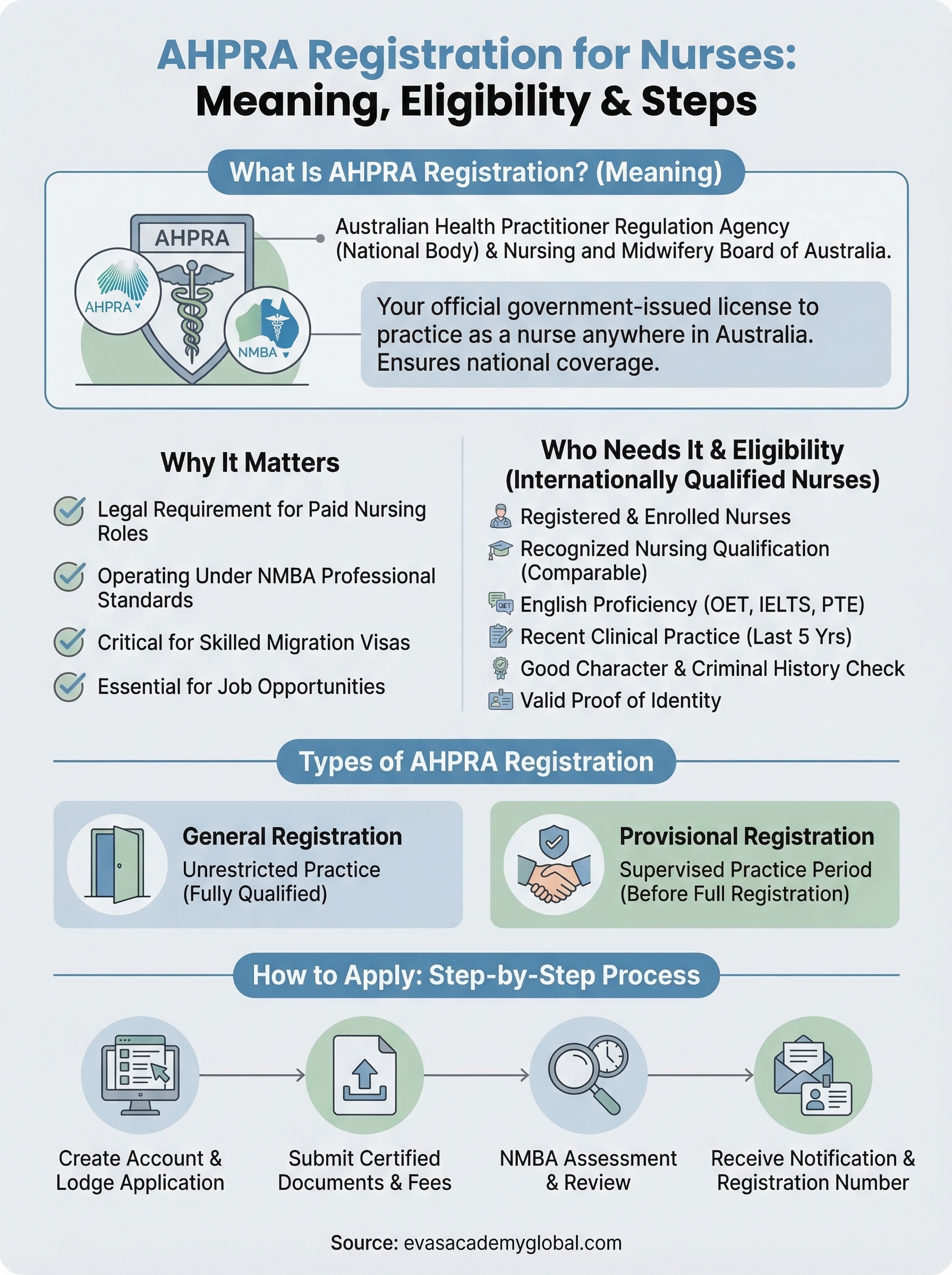
AHPRA stands for the Australian Health Practitioner Regulation Agency. It’s the national body responsible for registering and regulating health practitioners across Australia, working alongside 15 National Boards, including the Nursing and Midwifery Board of Australia (NMBA). When people ask what is AHPRA registration, the simplest answer is this: it’s your official government-issued license to practice as a nurse anywhere in Australia.
The organization behind the registration
AHPRA was established under the Health Practitioner Regulation National Law, which came into effect in 2010. Before AHPRA existed, each Australian state and territory ran its own separate registration system, which made it difficult for practitioners to move between states. Now, a single national registration covers you across the entire country, with very few exceptions.
Your AHPRA registration number is publicly searchable, which means employers, health facilities, and patients can verify your registration status at any time through the AHPRA website.
What your registration actually confirms
Your AHPRA registration confirms that you meet the standards set by the Nursing and Midwifery Board of Australia and are safe to practice. It ties directly to your personal details, your registration type, any conditions placed on your practice, and your annual renewal date. If your registration lapses or gets suspended, you cannot legally work as a nurse in Australia until it’s reinstated.
Internationally qualified nurses face an additional layer in this process. You must demonstrate that your overseas qualifications and clinical experience are comparable to Australian standards. AHPRA reviews your credentials, and the NMBA makes the final decision on whether you’re eligible for registration outright or whether you need to complete a supervised practice period or pass further assessments first.
Why AHPRA registration matters for nurses
AHPRA registration is not just a formality. It is the legal foundation of your nursing career in Australia. Without valid registration, you cannot accept any paid nursing role, and any work performed without it exposes both you and your employer to serious legal consequences.
Legal protection for you and your patients
Registered nurses in Australia operate under a clear framework of professional standards set by the NMBA. Your registration confirms you have met those standards and are accountable to a national regulatory body. If something goes wrong clinically, valid registration also provides a structured process for resolution rather than leaving you legally exposed.
AHPRA registration gives you full national coverage, meaning your license is recognized in every Australian state and territory without reapplying.
Career and visa implications
Understanding what is AHPRA registration becomes even more critical when you factor in your visa pathway. Most skilled migration visas for nurses, including subclass 189 and 190, require you to hold or be eligible for AHPRA registration as part of your skills assessment.
Your AHPRA registration also directly affects your job opportunities. No Australian hospital or health facility will hire you into a nursing role without confirmed registration, so securing it early keeps your entire career timeline on track.
Who needs it and basic eligibility criteria
Any nurse who wants to practice in Australia must hold AHPRA registration, whether you trained domestically or overseas. If you’re an internationally qualified nurse asking what is AHPRA registration and whether it applies to you, the answer is yes. Every nurse working in Australia, from enrolled nurses to registered nurses, requires valid registration before stepping into any clinical role.
Nurses who must register
Registered nurses and enrolled nurses across all employment types, including casual, part-time, and full-time roles, must hold current AHPRA registration. This requirement applies regardless of your visa type.
Nurses on working holiday visas, skilled worker visas, and permanent residency pathways all fall under the same registration rules. There are no exemptions based on employment duration or contract length.
You cannot begin work in any Australian nursing role, even on a trial or casual basis, without confirmed registration.
Basic eligibility requirements for internationally qualified nurses
To meet the NMBA’s eligibility requirements, you need to demonstrate the following:
- A recognized nursing qualification comparable to Australian standards
- English language proficiency through OET, IELTS, or PTE Academic
- Recent clinical practice within the last five years
- A good character declaration and criminal history check
- Valid proof of identity documents
Types of AHPRA registration you may need
When you understand what is AHPRA registration, the next step is knowing which type applies to your specific situation. The NMBA offers different registration categories, and the type you receive depends on your qualifications, English proficiency results, and clinical assessment outcomes.

General registration
General registration is the standard category for fully qualified registered nurses who meet all NMBA requirements. If your overseas qualifications are assessed as comparable to Australian standards and you meet the English language and recency of practice requirements, this is the registration type you’ll receive.
General registration gives you full, unrestricted rights to practice as a registered nurse anywhere in Australia without additional conditions.
Provisional registration
Provisional registration applies when the NMBA determines you need a supervised practice period before gaining full registration. This typically happens when your overseas clinical training does not fully align with Australian competency standards. You’ll work under an approved supervisor for a defined period, demonstrating your skills in a real clinical setting. Once you complete the supervised period satisfactorily, you can apply to transition to general registration and practice without restrictions.
How to apply and what to expect step by step
Once you understand what is AHPRA registration and which type applies to you, the actual application follows a defined sequence of steps. You submit everything through the AHPRA online portal, and the NMBA reviews your documents before making a registration decision.

Create your account and lodge your application
Start by creating your AHPRA online account at the official AHPRA website. From there, you select the Nursing and Midwifery Board, choose your registration type, and complete the form. You’ll need to upload your qualification documents, English language test results, criminal history check, and certified proof of identity.
- Pay the application fee as directed during submission
- Ensure all documents are certified and translated if they are not in English
What happens after you submit
After submission, AHPRA sends your file to the NMBA for formal assessment. Processing times vary, but allow several weeks to a few months depending on how complete your documentation is.
Incomplete applications are the most common reason for delays, so check every document carefully before you submit.
Your notification letter will confirm your registration type, any conditions attached, and your registration number, which takes effect immediately upon approval.
Next steps
Now you have a clear picture of what is AHPRA registration, who needs it, and how the application process works. The path forward starts with getting your documents in order, booking your English language test, and confirming whether your overseas qualifications will require additional assessment by the NMBA. Do not wait until you have a visa offer to start this process. Registration takes time, and getting ahead of it puts you in a much stronger position when employers come calling.
OSCE preparation is often the step that catches internationally qualified nurses off guard. If the NMBA determines you need a clinical assessment, your performance in that exam directly decides your registration outcome. That is where structured, expert-led training makes a real difference. EVA’S Academy Global has helped hundreds of nurses pass their OSCE and move forward with confidence. Explore our OSCE and nursing exam training programs and take the next step toward your Australian nursing career today.