17 Therapeutic Communication Techniques In Nursing
 By
By 
Every nurse-patient interaction starts with communication, and the quality of that communication directly shapes clinical outcomes. Whether you’re calming an anxious pre-op patient or gathering a health history, therapeutic communication techniques in nursing are the foundation of safe, patient-centered care.
These techniques go beyond casual conversation. They are structured, intentional skills that help you build trust, assess needs, and guide patients toward better health decisions. They also happen to be heavily tested on licensing exams like the NCLEX-RN, OSCE, and Prometric, something we see firsthand at EVA’S Academy Global For Nurses, where we’ve spent over 11 years training nurses to pass these exams and launch international careers.
This article breaks down 17 therapeutic communication techniques with clear definitions, practical examples, and clinical scenarios you can apply at the bedside or use to prep for your next exam. Each technique is explained in plain language so you can recognize it in practice and in test questions. Let’s get into it.
1. OSCE-first practice with EVA’S Academy Global
The OSCE is not just a clinical skills test. Examiners score your communication as heavily as your clinical actions, and nurses who walk in without deliberate preparation for this often lose marks they had no reason to lose. At EVA’S Academy Global For Nurses, our structured approach puts communication skills at the center of every station rather than treating them as an afterthought.
Why therapeutic communication decides OSCE marks
In an OSCE station, everything you say is observed, from how you introduce yourself to how you respond when a simulated patient shows distress. Examiners use structured marking rubrics, and communication items can account for a significant portion of your total score. Mastering therapeutic communication techniques in nursing before your exam gives you a reliable framework to fall back on even when nerves kick in.
Candidates who lose marks in OSCE stations most often do so because of how they spoke, not what they did clinically.
How to build an OSCE-ready communication flow for any station
You need a repeatable structure you can apply at the start of every station. This means introducing yourself clearly, confirming the patient’s name, stating your purpose, and asking an open question before moving to clinical tasks. EVA’S Academy Global trains nurses to build this sequence into muscle memory so it becomes automatic under timed exam pressure, regardless of which station you face.
How to self-check tone, clarity, and empathy under time pressure
When time is tight, your tone is the first thing to slip. Practice pausing for two to three seconds before responding to a patient’s emotional statement rather than jumping straight to a clinical instruction. Ask yourself: does your answer acknowledge what the patient just said? A brief empathic acknowledgment before any instruction keeps your communication therapeutic and your examiner’s tick box filled.
How to practice role-plays and get feedback for fast improvement
Role-play with a trained assessor is the fastest way to close communication gaps before exam day. At EVA’S Academy Global, our trainers run structured mock OSCE stations and deliver specific, station-by-station feedback on language choices, body language, and therapeutic response quality. Recording your own practice sessions and reviewing them adds another honest layer of self-assessment that accelerates improvement far more than reading alone ever could.
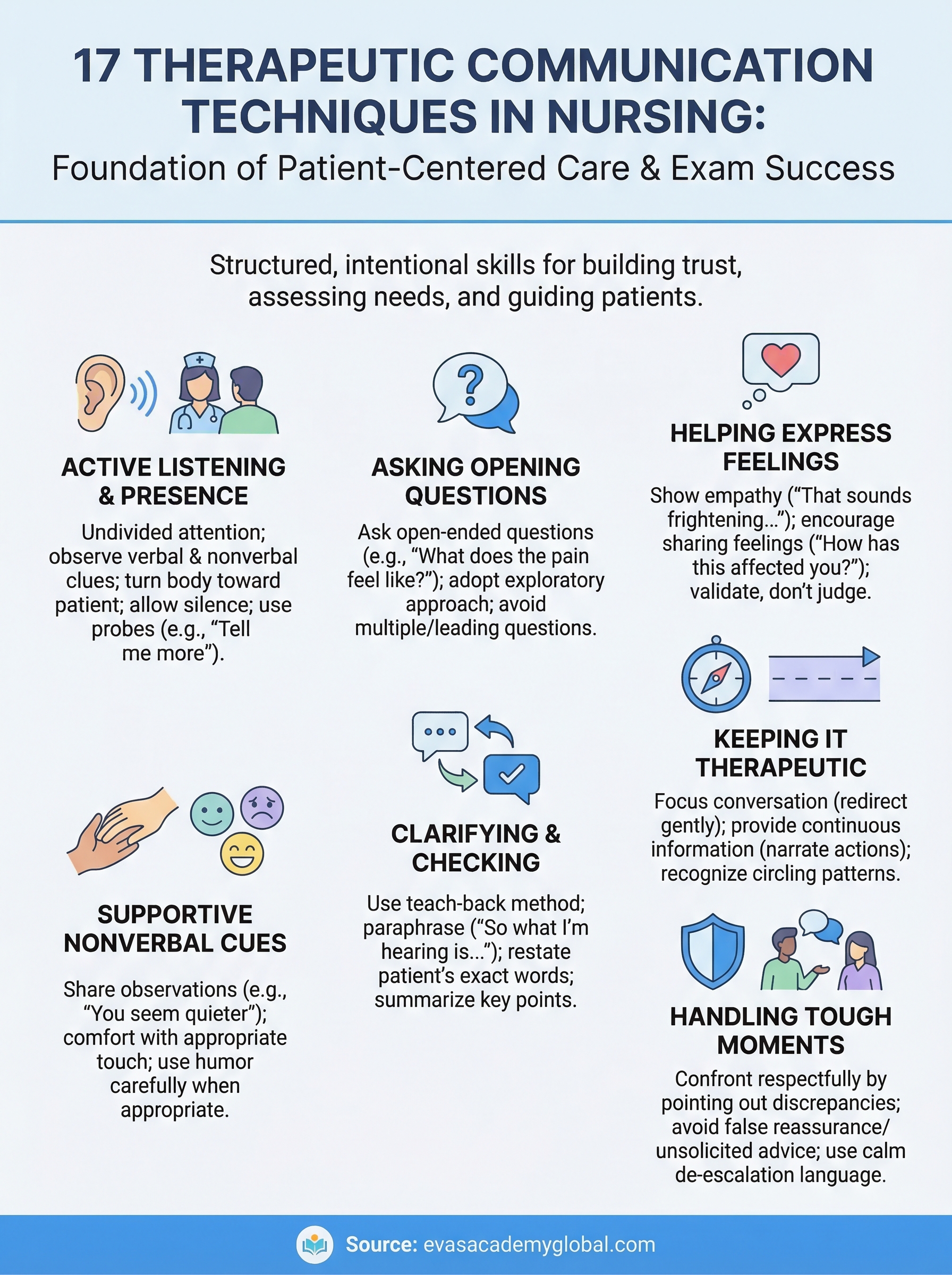
2. Active listening and presence
Active listening is one of the most foundational therapeutic communication techniques in nursing. It means giving a patient your full, undivided attention, not just waiting for them to finish speaking so you can respond. Without this presence, every other communication technique you apply loses its grounding.

Engage in active listening
When you engage in active listening, you focus on both the verbal and nonverbal messages your patient sends. This means maintaining comfortable eye contact, nodding to show you’re following, and keeping your body turned toward the patient rather than facing a screen or chart. These physical signals tell your patient that what they say matters to you.
Active listening is not a passive skill; it requires deliberate, conscious effort every time you enter a patient’s room.
Give your patients the chance to speak
Many nurses unconsciously interrupt or redirect patients too quickly. Instead, allow silence to work in your favor. A brief pause after a patient speaks gives them space to add more, and it signals that you are processing what they said rather than rushing to the next clinical task. Let patients complete their thoughts before you respond, and you will gather far more accurate clinical information.
Use probes or leads
Probes and leads are short, encouraging phrases or questions that invite patients to continue speaking without steering the direction of the conversation. Phrases like “Tell me more about that” or “Go on” keep the patient in control of the narrative. This technique is especially useful during history-taking, where patients often hold back relevant details until they feel fully heard and trust that you are genuinely engaged.
3. Observing and using supportive nonverbal cues
Nonverbal communication often carries more weight than the words you choose. Patients read your body language, facial expressions, and physical positioning constantly, even when they say nothing. Developing awareness of these signals is a core part of applying therapeutic communication techniques in nursing with consistency.
Share your observations
When you notice a change in a patient’s appearance or behavior, naming it directly opens the door to honest conversation. Saying “You seem quieter than usual today” gives patients permission to talk about what they are experiencing without feeling interrogated.
Sharing an observation invites the patient to respond on their own terms, which often yields more accurate clinical information than direct questioning.
This technique shows attentiveness and signals that you are paying close attention to them as a whole person, not just their chart.
Comfort patients using touch
Appropriate touch, such as a reassuring hand on the forearm, can reduce anxiety and reinforce that you are present with the patient. Always read the patient’s body language before initiating any contact.
Respect cultural and personal boundaries around touch at all times. A patient who stiffens or pulls away is communicating something important, and you should respond to that signal immediately.
Use humor when appropriate
Humor, used carefully, can ease tension and normalize a clinical encounter. It works best when the patient initiates it or when the relationship is established enough to support a lighter moment.
Never use humor to deflect a serious concern or minimize distress. Misjudged humor breaks trust and can derail the therapeutic relationship you have worked to build.
4. Asking questions that open the conversation
Knowing when and how to ask a question separates a nurse who gathers surface information from one who uncovers the full clinical picture. Among the therapeutic communication techniques in nursing, question design directly influences how much a patient shares and how accurate your assessment becomes.
Ask relevant questions
Open-ended questions give patients freedom to describe their experience in their own words rather than responding with a simple yes or no. Instead of asking “Are you in pain?” try “What does the pain feel like, and when did it start?” This approach pulls in richer detail, reduces the chance of a leading response, and shows the patient that you are interested in their full story.
The quality of your questions determines the quality of the information you receive, and that information shapes every clinical decision that follows.
Relevant questions also stay focused on the patient’s current concern. Avoid jumping between topics or asking multiple questions at once, as this confuses patients and breaks the flow of conversation. One clear, well-timed question is always more effective than three rapid-fire ones.
Adopt an exploratory approach
An exploratory approach means you follow the patient’s lead rather than pushing through a rigid question list. When a patient mentions something unexpected, such as a new symptom or a concern about their home situation, treat that as an invitation to dig deeper before moving on. Phrases like “Can you tell me more about that?” signal that you are genuinely listening and willing to adjust your assessment accordingly.
Building this flexibility into your routine helps you surface clinically significant information that a structured checklist would miss entirely.
5. Clarifying and checking accuracy
Misunderstandings between nurses and patients lead to medication errors, missed symptoms, and broken trust. Clarifying and checking accuracy is a group of therapeutic communication techniques in nursing that ensures both you and your patient are working from the same understanding before any clinical decision moves forward.
Clarify the details of treatments
When patients receive new information about their care, they often nod along without fully understanding what they heard. Ask your patient to repeat back the key points in their own words, and use that response to identify gaps before they leave the room. This approach, commonly called the teach-back method, catches confusion early and reduces preventable errors.
- “Can you walk me through how you’ll take this medication at home?”
- “What will you do if that symptom comes back?”
Paraphrase to clarify
Paraphrasing means restating what your patient said in your own words and checking whether you understood correctly. It signals that you were listening, and it gives the patient a direct opening to correct anything you missed. A phrase like “So what I’m hearing is…” works across most clinical settings.
Paraphrasing turns a one-way exchange into a genuine two-way conversation, which is where accurate assessment actually happens.
Restate for certainty
Restating involves repeating the patient’s exact words back to highlight a specific point worth exploring. This technique signals that their words carry weight and invites them to confirm or expand on what they shared.
Summarize
Summarizing pulls together the key points of a conversation at the end of an assessment. It gives your patient a clear picture of what was discussed, and it confirms that nothing important was missed before you close the interaction.
6. Helping patients express feelings
Patients rarely volunteer their emotional state unless they feel safe enough to share it. Two of the most important therapeutic communication techniques in nursing sit in this category, and developing them gives you real influence over how open and honest a patient is willing to be throughout their care.
Show empathy
Empathy means acknowledging a patient’s emotional experience without judging it or rushing to fix it. When a patient says they are scared about a diagnosis, the therapeutic response is not to reassure them immediately with statistics. Instead, you pause and say something like “That sounds really frightening, and it makes sense that you’d feel that way.” This validates their experience before any clinical response follows.
Patients who feel emotionally validated are more likely to share accurate information, follow through on care plans, and trust your clinical guidance.
Empathy is a deliberate communicative act, not just a feeling you either have or do not have. You can practice it by naming the emotion you observe, connecting it to the patient’s situation, and giving them a moment to respond before moving forward.
Encourage patients to share their feelings
Some patients hold back because they think their emotions are irrelevant to clinical care. Your job is to signal that feelings are part of the picture. Phrases like “How has all of this been affecting you?” or “What’s been the hardest part of this for you?” open space for emotional disclosure without forcing it.
Follow any emotional response with attentive silence or a brief acknowledgment before redirecting to clinical tasks. That pause communicates more than most words could.
7. Keeping the conversation therapeutic and on track
Even with strong intentions, clinical conversations drift. A patient starts describing one symptom and ends up talking about their neighbor’s recovery from a similar procedure. Redirecting without dismissing is one of the most underrated therapeutic communication techniques in nursing, and it requires both confidence and tact to do well.
Focus the conversation
When a conversation loses direction, your job is to bring it back gently without shutting the patient down. Use bridging phrases like “That’s helpful context, and I’d like to come back to what you mentioned earlier about your pain” to acknowledge what was shared while steering toward the clinically relevant topic.
Patients do not always know which details matter most, so your ability to redirect without dismissing keeps the assessment accurate and the relationship intact.
Staying focused also means recognizing when a patient circles a subject without landing on it. If that pattern appears, name it directly and invite them to share what is really on their mind. That honest, direct approach opens the door far faster than waiting for the patient to find their way there on their own.
Provide continuous information
Patients stay more cooperative and less anxious when they understand what is happening and what comes next. Throughout any clinical interaction, narrate your actions and intentions clearly. Saying “I’m going to check your blood pressure now, and then I’ll explain what we found” reduces uncertainty and fear before either has a chance to build.
Continuous information-sharing also includes updating patients when plans change. A brief, honest explanation of a delay or a shift in treatment keeps patients engaged and informed rather than anxious and guessing.
8. Handling tough moments with professionalism
Difficult conversations are unavoidable in nursing. Whether a patient challenges your instructions or becomes emotionally volatile, knowing how to respond without losing your therapeutic stance protects both the patient and your professional credibility. The therapeutic communication techniques in nursing covered in this section give you a reliable framework for staying grounded when the interaction gets hard.

Learn how to confront patients
Confrontation in nursing does not mean aggression. It means pointing out a discrepancy between what a patient says and what you observe. If a patient insists they feel fine while wincing with every movement, you can say “You’re telling me you’re okay, but I notice you’re guarding your side.” This opens a direct, honest dialogue without accusations.
Naming a contradiction respectfully gives patients a safe opening to share what they are actually experiencing.
Common non-therapeutic responses to avoid in exams and practice
Some responses shut conversations down fast. Watch out for these patterns whether you’re in a clinical setting or sitting an exam:
- False reassurance: “Everything will be fine” dismisses the patient’s real concern
- Giving unsolicited advice before the patient has finished speaking
- Changing the subject when a patient raises something emotionally charged
These patterns appear frequently in NCLEX and OSCE questions as the incorrect answer option, and recognizing them is a fast way to improve your exam score and your clinical habits at the same time.
De-escalation language that keeps patients safe and cooperative
When a patient becomes frustrated or agitated, your words are your primary tool. Use a calm, low tone and keep your sentences short and clear. Phrases like “I hear that you’re frustrated, and I want to help you work through this” acknowledge the emotion and redirect toward a solution without escalating the situation further.
Quick recap and next steps
You now have a working reference for all 17 therapeutic communication techniques in nursing covered in this article. From active listening and empathy to confrontation and de-escalation, each technique gives you a specific, repeatable tool you can use at the bedside and in exam stations. The goal is not to memorize a list but to practice these skills until they become automatic in real clinical interactions.
Applying these techniques consistently takes deliberate effort, and exam environments add an extra layer of pressure that only structured practice can reduce. If you are preparing for the OSCE, NCLEX-RN, IQN, or any other licensing exam, building your communication skills alongside your clinical knowledge makes a measurable difference in your results.
Start your exam preparation with EVA’S Academy Global and get expert-guided training that puts communication at the center of every station from day one.