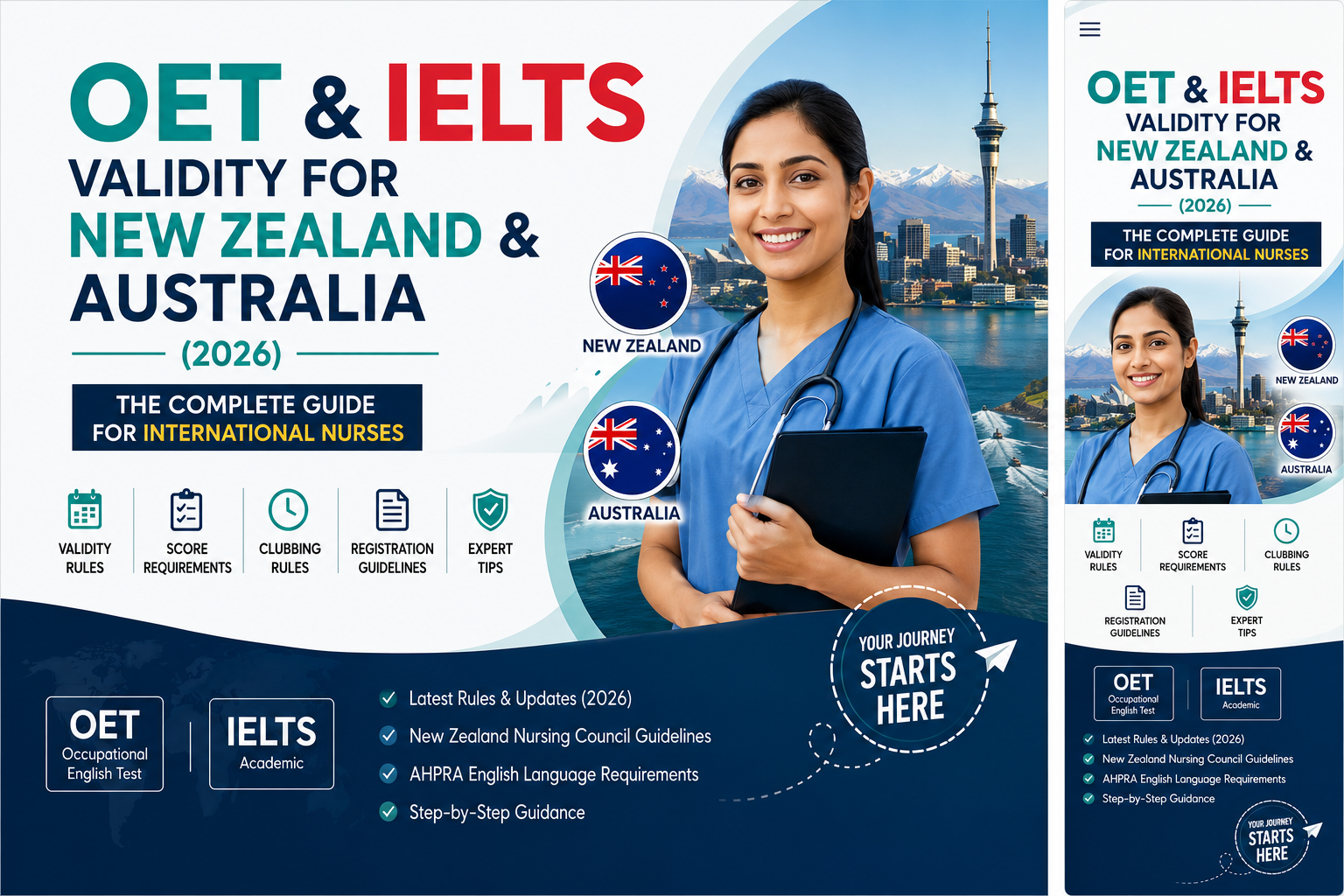
Last verified 19 July 2026, checked directly against the Nursing Council of New Zealand’s English Language Competence Policy Guidance (19 August 2022). NCNZ can update this guidance without much notice; confirm current figures on NCNZ’s live page before relying on any number in this post.
Quick answer: OET and IELTS results don’t expire in a simple, fixed sense for New Zealand nursing registration. What matters is that all test sittings you use in your application fall within three years of when you commence your Nursing Council of New Zealand (NCNZ) application, and that all required scores across those sittings are achieved within 12 months of your first sitting. That three-year window is counted from when your CGFNS report is transmitted to NCNZ, not from your test date, which is a meaningfully later point in most candidates’ timelines. The current minimums are OET 350/350/350/300 (Listening/Reading/Speaking/Writing) or IELTS Academic 7.0/7.0/7.0/6.5.
In this guide
- What OET and IELTS actually test
- Why NCNZ requires English tests
- The three English language evidence pathways
- Score requirements and the clubbing rules
- Accepted testing modes
- What “commencing your application” actually means
- What the CVS-NCNZ application actually requires, document by document
- How OET’s numeric scoring works
- Preparation tips by skill
- A fuller preparation checklist
- Booking your test correctly
- Which test should you take?
- Why the writing score requirement changed in 2022
- What else NCNZ checks, beyond English
- Two illustrative scenarios
- Common mistakes that cost nurses months
- A realistic timeline
- Myth vs. fact
- Why nurses choose to train with EVA’S Academy
- Where these figures come from, and how to stay current
- FAQ
Thousands of internationally qualified nurses pass OET or IELTS and then discover, sometimes years later, that timing matters more than they expected. The test itself isn’t usually the hard part. Understanding exactly how long a result stays usable, and under what conditions, is where confusion, and costly delay, usually happens.
This guide lays out the current rules for New Zealand APC registration specifically, checked directly against NCNZ’s own published policy guidance rather than older blog posts that may not reflect the current version.
What OET and IELTS actually test
OET (Occupational English Test) is built specifically for healthcare professionals. All four components, Listening, Reading, Writing, and Speaking, use clinical scenarios: patient consultations, referral letters, handover communication. Nurses often find it more directly relevant to their day-to-day work than a general academic test.
IELTS Academic is a general academic English exam, also assessing Listening, Reading, Writing, and Speaking, but through education, science, and general-interest content rather than clinical scenarios. It’s accepted by more institutions worldwide and has a longer track record with immigration authorities, which is part of why many nurses still default to it. Note it must specifically be IELTS Academic; General Training is not accepted for NCNZ registration.
Neither test is officially “easier.” Nurses comfortable with clinical vocabulary and patient-facing communication often perform better on OET. Nurses more confident with academic English, or who need the score for other purposes, often prefer IELTS.
Why NCNZ requires English tests
This isn’t bureaucracy for its own sake. Nurses communicate constantly, with patients, doctors, pharmacists, and multidisciplinary teams, often under time pressure and in situations where a misunderstanding has real consequences. A missed detail in a handover or a misread medication instruction isn’t a minor error in this profession.
New Zealand’s requirement has a specific legal basis: under the Health Practitioners Competence Assurance Act 2003, NCNZ must be satisfied that a nurse can communicate at an appropriate level to practise in their scope, and that their ability to communicate and comprehend English is sufficient to protect the health and safety of the public. If NCNZ isn’t satisfied of that, registration can’t be granted, regardless of clinical competence.
New Zealand’s Health and Disability Commissioner has told NCNZ that communication issues feature in around two-thirds of all complaints the Commissioner’s office receives, with language barriers sometimes raised specifically and having a disproportionate impact on disabled and older patients. That’s the practical reason the bar for nursing registration sits higher than what immigration or study purposes alone would require.
The three English language evidence pathways
NCNZ recognizes three ways to demonstrate English language competence, and you’re not automatically limited to the test.
1. Test-based pathway. The one most internationally qualified nurses use: pass OET or IELTS Academic at or above the required scores. Anyone is eligible for this pathway regardless of where they were educated or are currently registered.
2. Education-based pathway. If your initial nursing education was taught and examined in English in one of five recognized countries, currently Canada, Ireland, Singapore, the United Kingdom, and the United States, you may not need to sit a separate test. This applies specifically to the education that led to your initial registration, not postgraduate or post-experience study completed later in one of these countries. You’ll typically be invited into this pathway automatically if you’re eligible, when your application is first reviewed.
3. Registration-based pathway. If you’re already registered in one of four countries where an English test was required to obtain that registration, currently Canada, Ireland, the United Kingdom, and the United States, that existing registration can substitute for a new English test. This list is narrower than the education-based list: Singapore isn’t included here. It also doesn’t apply if your registration in one of these countries happened to be granted without an English test (this does happen in some US and Canadian states, and under certain historical UK arrangements), even if a test is normally required there.
If you completed your initial nursing education in one of the eligible countries, NCNZ recommends applying under the education-based pathway rather than the registration-based one.
Score requirements and the clubbing rules
Current minimum scores for the test-based pathway, verified directly against NCNZ’s own published guidance:
| Test | Reading | Listening | Speaking | Writing |
|---|---|---|---|---|
| OET | 350 | 350 | 350 | 300 |
| IELTS Academic | 7.0 | 7.0 | 7.0 | 6.5 |
Combining scores across sittings (“clubbing”) is allowed, under two conditions that both have to be met:
- Rule 1: all required scores must be achieved within 12 months of your first sitting.
- Rule 2: all sittings used in your application must fall within three years of commencing your NCNZ application.
All results used together must come from the same test. You cannot combine an OET score with an IELTS score to meet the requirement, for example using OET for Reading and Writing and IELTS for Listening and Speaking.
Accepted testing modes
Tests must be conducted at an OET or IELTS testing centre, either on paper or on computer. NCNZ does not currently accept testing conducted completely online, such as OET@Home. The only exception is the speaking component of OET’s “on computer” venue-based option, which is accepted as part of that testing mode.
What “commencing your application” actually means
This phrase does a lot of quiet work in NCNZ’s three-year rule, and it’s worth being precise about it rather than assuming. Confirmed directly from NCNZ’s own guidance: the three-year window is measured from when your CGFNS (now operating as TruMerit) Credentials Verification Service report is transmitted to the Nursing Council, not from when you first sit a test, first create an account, or first start preparing.
For most internationally qualified nurses, the path to NCNZ runs through CGFNS’s Credentials Verification Service for NCNZ (CVS-NCNZ) first. Here’s the practical sequence: you create a CGFNS account and submit your identity, education, employment, and English test documentation to them. CGFNS verifies and authenticates everything, which typically takes around 30 days once they’ve received all required documents. Once your report is ready, you get 30 days to review and approve it before CGFNS transmits it to NCNZ. From that transmission date, your three-year window for English test sittings is counted backward, and NCNZ’s own assessment process typically takes up further time once your application reaches them.
The practical implication: if you sat your English test early in your preparation but delayed starting the CGFNS process, your effective window is smaller than three years from your test date, since the clock is tied to the CGFNS report transmission, which happens later. CGFNS itself recommends submitting test results that are less than two years old at the point of report submission, specifically to leave a buffer for their own processing time before the three-year NCNZ deadline could become a problem.
One more detail worth knowing: NCNZ also generally requires at least 1,800 hours of post-registration nursing experience within the relevant period as part of the broader application, separate from the English test requirement. If you haven’t accumulated that yet, you can typically still start the CVS-NCNZ process, but it’s a separate clock from your English test validity and worth tracking alongside it, not instead of it.
How OET’s numeric scoring actually works
OET has always produced a numeric score from 0 to 500 for each of the four sub-tests, in 10-point increments. You may see the test referred to by letter grades (A, B, C+, C, D, E) in older articles or other contexts; those are a simplified way of communicating bands of the underlying numeric score. NCNZ’s own guidance references the numeric scale directly (the 350/350/350/300 figures above), so when you’re preparing against NCNZ’s requirements, focus on the numeric target rather than a letter-grade equivalent you might see quoted elsewhere.
Preparation tips by skill
Listening. Both tests use extended audio passages. For OET, practice with healthcare-context audio specifically, since general English listening practice alone won’t fully prepare you for clinical handover-style content. For IELTS, vary your practice sources across accents, since the test draws from multiple English-speaking regions.
Reading. Time pressure is usually the actual obstacle here, not vocabulary. Practice skimming for structure before reading in detail, and track your pace against the actual time limits rather than reading passages open-endedly.
Writing. This is the component where candidates most often fall short, and it’s rarely about grammar alone. For OET, the referral-letter format has specific conventions (what to include, what to leave out, appropriate register) that differ meaningfully from general essay writing. Practising against real OET writing criteria, not generic English-essay feedback, makes a measurable difference. For IELTS Academic Writing, Task 2’s argument structure is frequently under-practised relative to Task 1’s data description.
Speaking. Role-play practice matters more here than solo rehearsal. For OET specifically, the speaking test is built around simulated patient interactions, and practising with a partner who can respond unpredictably, rather than a fixed script, better reflects the actual test format.
What the CVS-NCNZ application actually requires, document by document
Since the CGFNS/TruMerit report transmission date is what starts your English test’s three-year clock, it’s worth understanding what that application actually involves, not just that it exists. Verified directly against CGFNS/TruMerit’s own applicant handbook:
Identity documents. Notarized copies of your passport plus one additional form of official identification, both showing your full current legal name with no abbreviations. If you’ve ever used a different name, on a previous qualification or license, for instance, you’ll need additional notarized documents linking that name to your current one. This name-matching requirement is a genuinely common source of delay: a maiden name on an old nursing license, or a name spelled slightly differently on a birth certificate versus a passport, can trigger extra verification steps that have nothing to do with your nursing competence or English ability.
Employment self-declaration. A self-declared record of your nursing employment, generally needing to demonstrate around 1,800 hours of practice within roughly the last five years.
Education documentation. Evidence of the qualification that led to your nursing registration, sometimes submitted by you directly, sometimes required to come straight from your education provider to CGFNS, depending on their specific process for your country.
Nursing license history. Records of every nursing license or registration you’ve held over the last five years, generally required to come directly from the relevant licensing authority rather than as a copy you provide yourself.
English language proficiency. Your OET or IELTS results, or your alternative-pathway evidence if you qualify for the education or registration-based routes.
If any of these documents are in a language other than English, they need certified translation; CGFNS does not accept translations submitted directly by the applicant, only from an approved certified translator.
One more timing detail worth knowing: once you purchase your CVS-NCNZ order, you generally have 12 months to get all required documents submitted before the order itself expires, separate from the three-year English test window this whole guide is about. It’s a shorter clock sitting inside the longer one, and losing track of it can force you to restart the whole credentialing process, English test validity included.
A fuller preparation checklist
This is a general orientation, not a substitute for NCNZ’s current requirements, which you should confirm directly.
- Confirmation of which test (OET or IELTS Academic) fits your preparation strengths.
- A booking at an approved test centre, on paper or computer, not an at-home format.
- A study plan that allocates real time to Writing specifically, not just proportional time across all four skills.
- A calendar note for your 12-month combining window, if you’re planning to use the clubbing pathway, so a second sitting doesn’t fall outside the eligible range.
- Digital and physical copies of your Test Report Form or OET Statement of Results, stored somewhere you can retrieve quickly during your registration application.
- A CGFNS (TruMerit) account created early, with document gathering started in parallel with your English test rather than after it, since the CGFNS report transmission date, not your test date, is what actually starts your 3-year window.
- A direct bookmark to NCNZ’s live English language requirements page, not a saved PDF from months ago, since this guidance can be updated with limited notice.
Booking your test correctly
A few practical details that have nothing to do with your English ability but can still derail an application:
- Double-check IELTS Academic versus General Training at the booking stage, not after you’ve sat the test. This is one of the most common and entirely avoidable errors candidates make.
- Book at an approved test centre, not an at-home or online variant, even if the online version is cheaper or more convenient. NCNZ does not currently accept fully remote testing.
- Keep your booking confirmation and candidate ID somewhere retrievable, since you’ll likely need to reference these details later in your registration application.
- If you’re planning to combine two sittings, book your second sitting with the 12-month window already in mind rather than discovering the deadline has passed after the fact.
Which test should you take?
There’s no universally correct answer. A few honest signals worth weighing:
Lean toward OET if: you’re more comfortable with clinical vocabulary and patient-facing scenarios, you already work in a hospital setting, and you find real-world context easier to engage with than abstract academic topics.
Lean toward IELTS if: you’re stronger in general academic English, you may need the score for a second purpose (further study, a skilled migration points calculation), or you’re more familiar with the test format from prior study.
Base your choice on which test format plays to your actual strengths, not on an assumption that one is universally “easier.”
Why the writing score requirement changed in 2022
The current OET 300 / IELTS 6.5 writing minimums aren’t NCNZ’s original standard; they replaced a stricter requirement (OET 350 / IELTS 7.0 for writing, matching the other three components) that was in place before 19 August 2022. NCNZ eased specifically the writing component following a consultation process examining whether the assessment process created unnecessary barriers for internationally qualified nurses, without compromising patient safety. Reading, Listening, and Speaking minimums were left unchanged in that review.
This matters practically for two reasons. First, if you’re looking at older articles, forum posts, or even printed material from before mid-2022, the writing figures you’ll see quoted are likely the old, stricter ones, not what’s currently required. Second, it’s a useful reminder that this policy has changed before and can change again; treating any specific number in this guide as permanent is a mistake, which is why we’ve dated and sourced everything here rather than presenting it as timeless fact.
What else NCNZ checks, beyond English
English language competence is one requirement among several NCNZ registration standards, and it’s worth knowing the shape of the rest so you’re not caught off guard by a different requirement late in your process.
Identity verification. Certified copies of identity documents, checked as part of your CGFNS submission before your report is even built.
Nursing qualifications. Your original qualification needs to be assessed as equivalent to a New Zealand nursing qualification, a Bachelor of Nursing or equivalent for Registered Nurses.
Recency of practice. NCNZ generally requires post-registration nursing experience within a defined recent period, commonly discussed as around 1,800 hours, though you should confirm the current figure directly rather than treat this guide as the authoritative number for that specific requirement.
Character and fitness to practise. Standard declarations and checks that apply across most health profession registrations internationally.
Competence assessment. Since 4 December 2023, most internationally qualified nurses go through a two-part competence assessment: an online IQN Theoretical Examination (120 multiple-choice questions across two parts, for Registered Nurses) taken at a Pearson VUE test centre, either in New Zealand or overseas, followed by a clinical OSCE that requires a short orientation and preparation course first. You get three attempts across the theoretical exam and three for the OSCE. This replaced the previous, longer supervised Competence Assessment Programme (CAP) that some older guides and forum posts still describe, so if you’re reading material from before late 2023, the process it describes may no longer match what NCNZ currently requires.
None of these run on the same clock as your English test validity, which is exactly why treating your registration as “just the English test plus paperwork” tends to catch candidates off guard. Track them as parallel requirements, not sequential ones.
Two illustrative scenarios
These are simplified, illustrative examples to show how the rules apply in practice, not real client case studies.
Scenario: partial pass, then combining. A nurse sits OET and passes Listening, Reading, and Speaking, but Writing comes in at 280, below the 300 minimum. She retakes only the Writing component five months later and scores 320. Because both sittings fall within 12 months of the first, and within three years of commencing her NCNZ application, these results may be combined under the test-based pathway. She doesn’t need to retake the full test.
Scenario: a long gap between testing and applying. A nurse sits IELTS in early 2023 but, due to changing personal circumstances, doesn’t create her CGFNS account or start gathering documents until mid-2025. By the time CGFNS verifies her documents (around 30 days) and she reviews and approves her report (up to 30 days) and it’s transmitted to NCNZ, her application effectively “commences” in late 2025, nearly three years after her test date. She’s likely still inside the window, but with little room to spare if any part of her document collection is delayed, and she’d want to confirm this precisely rather than assume comfortably.
Scenario: the timing gap most candidates don’t see coming. A nurse sits OET in January and assumes she has a full three years from that date. She spends the next eight months gathering documents at an unhurried pace before creating her CGFNS account in September. CGFNS verification and her own 30-day report approval window push her effective commencement date to around November, nearly a year after her test. If she’d assumed her three-year clock started in January, she’s lost almost a year of what she thought was buffer time, purely from not realizing the CGFNS transmission date, not the test date, is what counts.
Common mistakes that cost nurses months
- Waiting too long after passing, before starting the application. The clock that matters is tied to your application timeline, not just your test date in isolation.
- Relying on social media groups instead of official NCNZ guidance. Requirements can change with limited notice.
- Booking IELTS General Training instead of IELTS Academic. Only the Academic version is accepted.
- Assuming Writing and other components carry equal weight in preparation. Writing is frequently the component that trips candidates up, and it’s worth dedicated, targeted preparation rather than treating it as a formality.
- Assuming an English test alone guarantees registration. It satisfies one requirement among several NCNZ registration criteria.
- Mixing OET and IELTS results. All results used together must come from a single approved test.
A realistic timeline
Months 1-2: Research your pathway, choose OET or IELTS based on your actual strengths, and begin structured preparation.
Months 3-4: Sit the test. If a resit is needed for one component, plan it promptly, keeping the 12-month combining window in mind.
Around the same time: Create your CGFNS (TruMerit) account and begin gathering identity, education, and employment documentation for the CVS-NCNZ Credentials Verification Service, in parallel with your English test rather than after it.
Once documents are submitted to CGFNS: Verification typically takes around 30 days. You’ll then have 30 days to review and approve your report before CGFNS transmits it to NCNZ. This transmission date is the actual anchor point for your three-year English test window, so don’t treat it as a formality to delay.
After CGFNS transmits your report to NCNZ: NCNZ’s own assessment process takes further time from there. Respond promptly to any queries during this stage, since a slow response extends the timeline more than almost anything else in the process.
Throughout: Track your 1,800 hours of post-registration nursing experience alongside your English test and CGFNS timelines. It’s a separate requirement with its own logic, not a detail to leave until the end.
Myth vs. fact
| Myth | Fact |
|---|---|
| “OET and IELTS scores expire after exactly 3 years, full stop.” | The 3-year rule is tied to when sittings fall relative to commencing your NCNZ application, not a flat expiry date on the certificate itself. |
| “My 3-year window starts from my test date.” | It’s counted from when your CGFNS report is transmitted to NCNZ, which typically happens months after you sit your test, not from the test date itself. |
| “I can mix my best OET and IELTS scores together.” | No. Combined results must come from the same test; OET and IELTS scores cannot be mixed. |
| “OET@Home is accepted for NZ nursing registration.” | No, with one narrow exception limited to the speaking component of OET’s on-computer, venue-based option. |
| “General Training IELTS is fine if my score is high enough.” | No. NCNZ requires IELTS Academic specifically, regardless of your General Training score. |
| “NCNZ accepts PTE Academic or Cambridge English too.” | No. NCNZ’s own site states plainly it does not accept PTE, and OET and IELTS Academic remain the only two approved tests. This confusion likely comes from PTE and Cambridge being accepted for general New Zealand immigration or study purposes, which is a separate, broader standard than NCNZ’s nursing-specific requirement. |
Why nurses choose to train with EVA’S Academy
EVA’S Academy is a female-led, nurse-led organization, started specifically for the welfare of nurses going through this pathway. We work with candidates across a wide range of financial circumstances, and we offer flexible, case-by-case support for candidates who are genuinely struggling to afford full preparation costs, rather than treating cost as the deciding factor in who gets to pursue this journey.
Most of our team members have personally gone through this pathway themselves, and several have gone on to build their careers as New Zealand-registered nurses. That’s not a marketing detail; it directly shapes how we coach. When a candidate asks about a specific documentation question, a practice-hours gap, or what a particular stage actually feels like, our team is frequently answering from direct, recent, personal experience with that exact step, not a general understanding of the regulations.
We won’t claim to be the cheapest option in Kerala, since that’s not something we can verify against every other provider, and we’d rather not make a claim we can’t stand behind. What we can say honestly: our pricing is built to be accessible, and if cost is a genuine barrier for you, we’d rather have that conversation directly than have it be the silent reason you don’t pursue this.
The bottom line
English test validity for New Zealand nursing registration isn’t a single fixed rule; it’s a set of conditions that depend on your pathway and when your sittings and application actually happen. The rules are more forgiving than many nurses assume (score combining exists precisely to avoid forcing a full retake over one weak component), but only if you understand exactly how the timing conditions work before you plan around them. When in doubt, check NCNZ’s current published guidance directly rather than relying on any single article, including this one, since these requirements do change.
Reach out through our contact page to start that conversation, or read more about our team first.
Where these figures come from, and how to stay current
Every score, rule, and timeline detail in this guide was checked directly against NCNZ’s own published materials, not summarized secondhand from other blogs or forums. Specifically: NCNZ’s English Language Competence Policy Guidance (19 August 2022), NCNZ’s public FAQ pages on nursingcouncil.org.nz, and CGFNS/TruMerit’s own applicant guidance on the CVS-NCNZ process.
We’re naming these sources deliberately, because the single most useful thing you can do with this guide isn’t to trust it indefinitely, it’s to know exactly where to check it yourself before you rely on any figure for your own application:
- NCNZ’s English language requirements: the current policy guidance and FAQ pages on nursingcouncil.org.nz.
- CGFNS/TruMerit’s CVS-NCNZ process: the applicant handbook and portal at the CGFNS website, for current timelines and document requirements.
- NCNZ’s broader registration standards: covering qualifications, recency of practice, and character requirements, also on nursingcouncil.org.nz.
Bookmark the primary pages, not just this post. Guidance like this changed once already in 2022, without a lot of advance notice, and there’s no reason to assume it won’t change again.
Frequently Asked Questions
Does NCNZ accept PTE, TOEFL, Cambridge, or CELPIP for nursing registration?
No. As of this guide’s last verification, NCNZ’s own site explicitly states it does not accept PTE, and only OET and IELTS Academic appear anywhere in its published English language guidance. CELPIP, TOEFL, and Cambridge don’t appear in NCNZ’s accepted-test list at all; these are commonly accepted for other countries’ immigration processes or general New Zealand study visas, which is a different, broader standard than NCNZ’s nursing-specific requirement.
Is OET accepted for New Zealand nursing registration? Yes, OET is one of two NCNZ-approved tests, alongside IELTS Academic, provided current score requirements and all other registration criteria are met.
Can I combine OET scores across two test sittings? Yes, provided all required scores are achieved within 12 months of your first sitting and all sittings fall within three years of commencing your NCNZ application.
Can I combine IELTS and OET scores together? No. Combined results must come from a single approved test; OET and IELTS scores cannot be mixed in one application.
Is IELTS General Training accepted for NZ nursing registration? No. NCNZ requires IELTS Academic specifically.
Is OET@Home accepted by NCNZ? No, with a narrow exception limited to the speaking component of OET’s on-computer, venue-based option.
What documents does the CVS-NCNZ application need besides my English test? Notarized identity documents, an employment self-declaration covering your nursing hours, education documentation, your nursing license history from the last five years, and certified translations for anything not originally in English. Confirm the current exact list directly with CGFNS/TruMerit, since specific requirements can vary by country of origin.
When does my 3-year window for combining test scores actually start counting? From when your CGFNS report is transmitted to NCNZ, not from your test date. Since the CGFNS verification and approval process typically takes around two months on top of your own document preparation time, your effective window is shorter than three years from your test date in practice.
How many hours of nursing experience do I need alongside my English test? NCNZ generally requires at least 1,800 hours of post-registration nursing experience within the relevant period. This runs alongside your English test validity as a separate requirement, not a substitute for it.
Is passing OET or IELTS enough on its own to get registered in New Zealand? No. English competence is one requirement among several NCNZ registration criteria, alongside qualification assessment, identity verification, and a competence assessment for most internationally qualified nurses.
What does NCNZ’s competence assessment involve now, separate from the English test? Since 4 December 2023, most internationally qualified nurses complete an online IQN Theoretical Examination at a Pearson VUE test centre, followed by a clinical OSCE after a short orientation course. This replaced the previous, longer Competence Assessment Programme (CAP). It’s a separate requirement from your English test, with its own attempt limits (three each), and doesn’t share a timing window with your OET or IELTS validity.
Which test has a better pass rate, OET or IELTS? Neither is officially easier. Outcomes depend on individual strengths, preparation, and familiarity with the test format rather than the test itself.
Does EVA’S Academy offer support for nurses who can’t afford full fees? Yes, case by case, for candidates facing genuine financial hardship. Reach out directly to discuss your situation; we evaluate this individually rather than against a fixed public formula.
What’s the most common reason a New Zealand English test requirement causes delay? Usually a timing issue rather than a scoring one: waiting too long after passing to start the application, or a second sitting falling just outside the 12-month combining window.
For Expert advice and training Join Eva’s Academy NOW