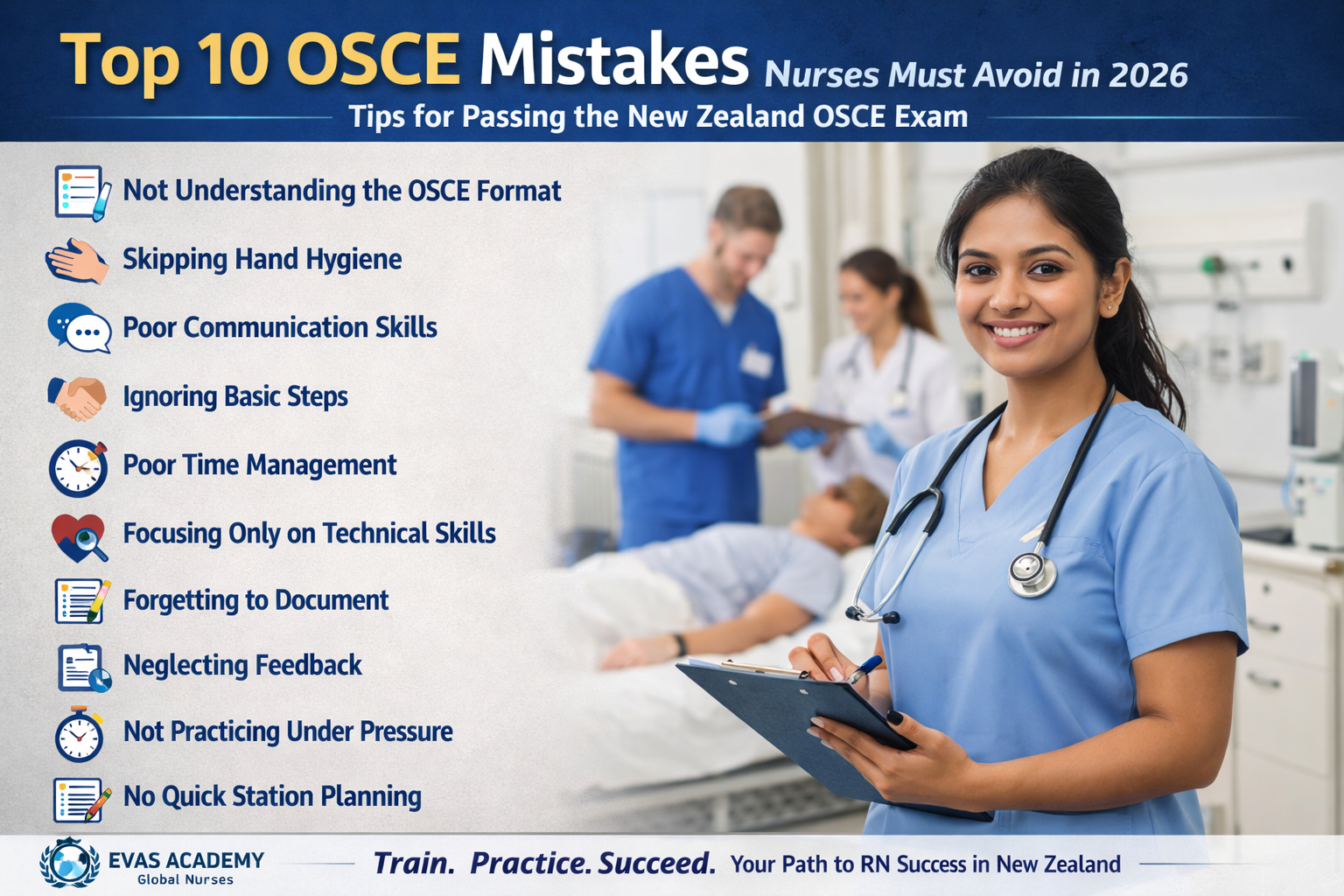
Updated for New Zealand Nursing Registration – By Eva’s Academy)
Becoming a Registered Nurse in New Zealand in 2026 requires successfully clearing the IQN pathway, including the OSCE (Objective Structured Clinical Examination). While many nurses have strong clinical knowledge, failure often happens due to avoidable mistakes in exam execution not lack of knowledge.
At Eva’s Academy, we train global nurses with a structured, exam-focused approach aligned to the latest OSCE scenarios and assessment standards.
Let’s break down the most common mistakes and how to avoid them.
1. Not Understanding the Updated OSCE Format (2026)
The OSCE is not a theory exam it is a competency-based clinical assessment. Each station evaluates critical areas like patient safety, communication, clinical reasoning, and procedural skills.
2026 Update Insight: Recent OSCE patterns show increased emphasis on clinical reasoning + patient-centered communication, not just task completion.
How to avoid this:
- Learn the latest station structure and marking criteria
- Practice real-time simulated scenarios
- Train with updated OSCE case patterns (not outdated modules)
2. Ignoring Infection Control (Hand Hygiene Errors)
Missing hand hygiene is still one of the fastest ways to lose marks.
2026 Focus: Strict adherence to WHO 5 Moments of Hand Hygiene is consistently assessed across stations.
How to avoid this:
- Build automatic hand hygiene habits during every practice
- Integrate infection control into every OSCE step not as an afterthought
3. Poor Communication Delivery
Speaking too fast, too softly, or without structure reduces clarity and confidence.
2026 Trend: Examiners increasingly assess:
- Clinical explanation clarity
- Patient reassurance
- Professional tone
How to avoid this:
- Use structured communication (introduce → explain → check understanding → close)
- Practice voice modulation and pacing
4. Skipping Basic Professional Steps
Simple omissions like not introducing yourself or not taking consent can cost critical marks.
Essential OSCE flow:
- Knock and enter
- Introduce yourself
- Confirm patient identity
- Obtain consent
- Explain procedure
These are non-negotiable in 2026 marking rubrics.
5. Poor Time Management
Reality
Station completion is not mandatory for passing the OSCE.
Completing a station fully is always ideal and scores higher. However, an incomplete station does not automatically result in a fail.
👉 What matters is what you prioritized and demonstrated within the time.
Key Principle
- Completion = Strong performance
- Partial completion with correct priorities = Still passable
- Poor prioritization = Risk of failure
How Examiners Actually Assess
Even if you don’t finish:
- Did you identify key clinical issues?
- Did you perform essential safety steps?
- Did you demonstrate clinical reasoning?
- Did you maintain patient-centered care?
👉 If YES → You can still pass the station
Where Candidates Go Wrong
- Spending too long on non-essential details
- Missing critical actions (e.g., safety checks, escalation)
- Failing to transition to management
Correct Strategy
1. Prioritize Core Actions
- Focus on what is clinically important, not everything
- Cover:
- Key assessment
- Immediate management
- Safety considerations
2. Use Structured Progression
- Assessment → Management → Summary
- Even if brief, ensure all domains are touched
3. Verbalize When Time is Limited
Say:
- “Due to time, I will summarize my plan…”
- “I would proceed with…”
👉 This shows clinical awareness and decision-making
How to avoid this:
- Practice with strict timers
- Allocate time:
- Assessment
- Intervention
- Documentation
6. Over-Focusing on Technical Skills Only
Technical accuracy alone is not enough.
2026 Assessment Priority:
- Empathy
- Patient safety
- Communication
- Professional behaviour
How to avoid this:
- Treat mannequins/actors as real patients
- Show empathy verbally and non-verbally
7. Forgetting Documentation
Many candidates perform well but lose marks by skipping documentation.
How to avoid this:
- Always reserve time for charting
- Practice structured documentation formats
- Write clearly and clinically
8. Ignoring Feedback During Training
OSCE success is built on iteration and correction.
How to avoid this:
- Train under expert supervision
- Actively implement feedback
- Re-practice weak areas immediately
9. Not Practicing Under Exam Pressure
Comfort practice ≠ exam performance.
2026 Expectation: Candidates must demonstrate consistent performance under time pressure.
How to avoid this:
- Simulate real OSCE conditions
- Practice with countdown timers
- Build stress control techniques
10. Not Planning Before Starting the Station
Jumping into tasks without a plan leads to missed steps.
How to avoid this:
- Take 20–30 seconds to plan
- Mentally outline:
- Safety checks
- Key steps
- Closing summary
Why Nurses Choose Eva’s Academy in 2026
At Evas Academy, we don’t just teach—we simulate real OSCE success:
- Unlimited practice sessions
- Latest updated OSCE scenarios (aligned with real exams)
- Structured offline + online training
- Focus on clinical reasoning + communication
- Personalized feedback and performance tracking
Final Insight
Passing OSCE is not about being the smartest it’s about being prepared, structured, and consistent.
Avoiding small mistakes can be the difference between failure and registration.
